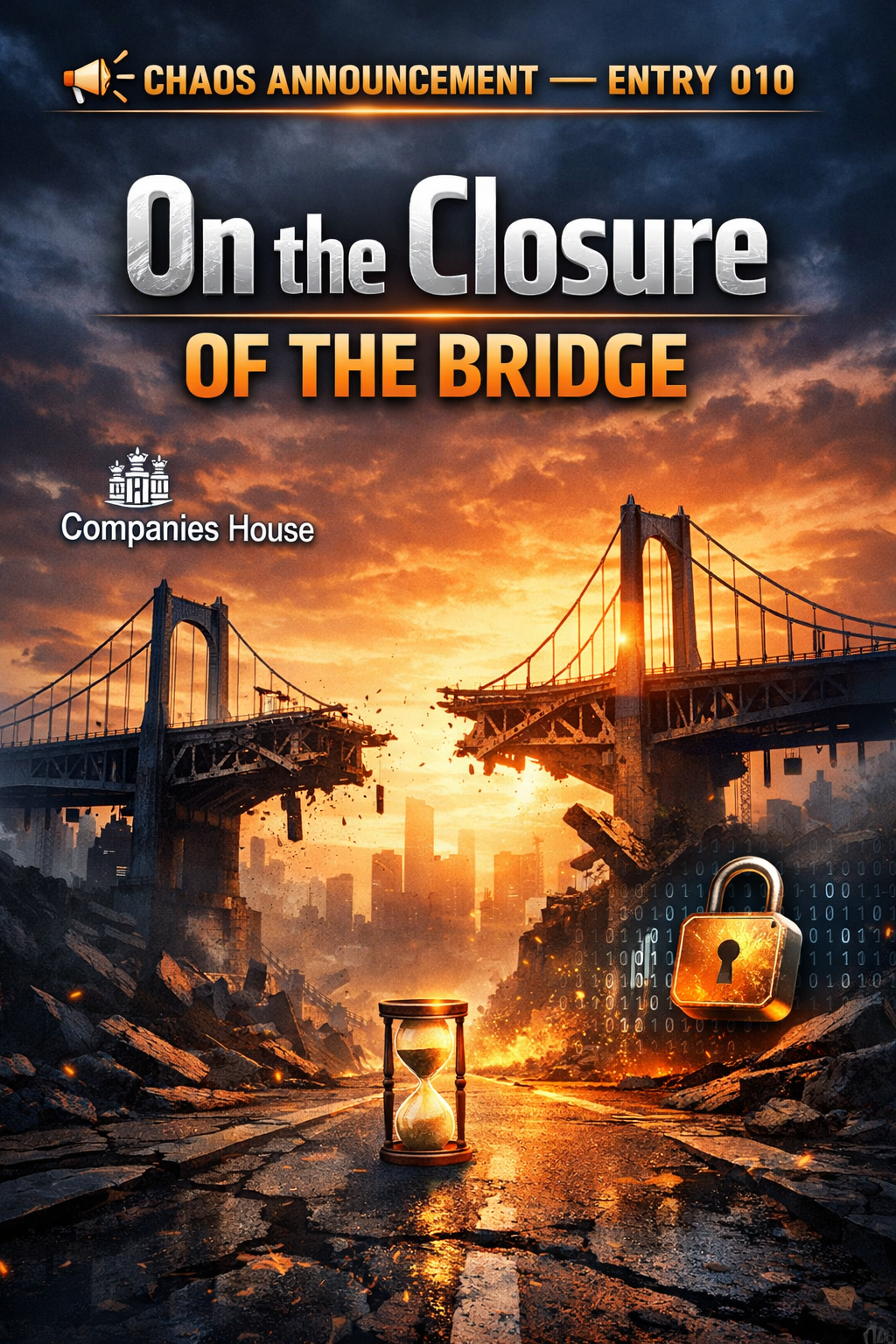
π’ CHAOS ANNOUNCEMENT β ENTRY 010
On the Closure of the Bridge
π§ Status
Nothing has escalated.
Nothing has collapsed.
This is not reaction.
Itβs acknowledgment.
βοΈ Reality has weight.
This entry exists to close something cleanly.
Not to dramatise it.
π§± On the Impossibility of Privacy β Early-Stage Clarification
At the beginning stage, there simply isnβt a version of this where complete privacy survives.
Thatβs not ideology.
Thatβs regulation.
ποΈ Corporate directors are compulsorily visible on public registers.
Companies House does not negotiate with intention, narrative, or preference.
If operations are real,
if entities are live,
if structures are legitimate,
then visibility exists at least at the corporate record level.
π« No workaround changes that.
π« No philosophy overrides it.
So the idea that I could remain fully private while initiating Phase I was always conditional.
That condition is now under review, not denial.
π On the Bridge Itself β Clarification, Risk & Conditional Removal
Previously, the idea of a potential bridge between this archive and future structures existed as a conditional possibility.
That condition hinges on one factor only:
β‘οΈ Whether the corporate director role can exist without being recorded on a public database.
Ownership can be structured.
Equity can be layered.
Trusts can buffer exposure.
π§ Those are manageable.
What is not negotiable is this:
If being a corporate director requires permanent placement on a public-facing register, rather than a private or internal database, then the bridge becomes a liability to privacy.
In that case, the bridge is removed.
Where required by law, I will be fully transparent but only at the points of absolute necessity.
This is manageable at the beginning.
I could work around that.
The difference is simple:
Without the bridge, exposure is limited strictly to what the law compels.
And if i am to function as a corporate director without early stage exposure, the bridge has to be removed.
As long as the bridge exists, it could introduce unnecessary linkage and attract unwarranted attention.
And during Phase I, thatβs not acceptable.
Especially during Phase I.
β³ Why the Deadline Exists β The 20 Boundary
By 20, the bridge will most likely be removed because beyond that point:
βοΈ Structures move from planning to execution
π Compliance shifts from hypothetical to required
π Visibility, once introduced, cannot be reversed
There is, however, a narrow window.
A tiny glimmer of hope. Nothing more.
If by 20:
π Laws change
ποΈ Corporate directors are no longer compulsorily public
π And may instead exist within a private or internal corporate registry
Then the bridge may be reconsidered in the early stage.
May.
Not promised.
Not expected.
And if we are being completely realistic, this change is highly unlikely.
But the condition is stated for completeness.
If it does not occur, the conclusion still stands.
πͺ The bridge will be removed.
β Indefinitely.
Not paused.
Not hidden.
Removed.
ποΈ Clarification on Why a Change Is Highly Unlikely β Structural Reality
A common question underpins this condition of mine:
βIf authorities and regulatory bodies could know privately, why must the public infringe on personal privacy?β
Because the public is part of enforcement.
Not metaphorically or conceptually.
Literally.
In the UK model:
π¦ Banks check you
ποΈ Regulators check you
βοΈ Courts check you
π AND the public checks you
That final layer is not optional.
It is a deliberate design choice.
Corporate transparency in this system does not rely solely on institutions.
It relies on distributed scrutiny.
ποΈ Companies House is not just a database.
It is a public notice board.
Its purpose is not comfort.
It is accountability.
Which is why the likelihood of corporate directorships being removed from public record and known only to them through an internal database is extremely low.
Not because it cannot be done.
But because doing so would dismantle a foundational enforcement layer the system depends on.
Humans.
And some just happen to be nosy.
And the only safe expectation you could make, is for companies house to act in the best interest of the people.
Which they already do.
Systematically.
This is why this condition is stated and not expected β
and why expectations will remain grounded at zero.
π Back to the Only Condition That Would Change Anything
Unless corporate directors are somehow able to exist within a private, internal government registry β
not a public-facing database β this position does not change.
ποΈ Known to banks
ποΈ Known to regulators
βοΈ Known to courts
But not browseable by the public.
Afterall, In the beginning stage of Nullpoint, i am most likely starting with a bare trust.
And if the only option left to directly manage the early stage entities during Phase I of Nullpoint is permanent placement on a public register, then the bridge will be removed.
Not emotionally.
Not ideologically.
Structurally.
ποΈ On Visibility, And The Workaround Alternative
Privacy is possible in the early stage of Nullpoint.
But that hinges on one fact only:
β‘οΈ Structuring.
Also as a different trust framework.
Furthermore, If i am to function using a bare trust in the early stage of Nullpoint, visibility in the form of a role will undoubtedly exist.
And beginnings matter.
They create past references.
That isnβt allowed.
I would prefer to keep plausible deniability and privacy.
Again, this is not intended secrecy, itβs intended privacy.
As to why i prefer privacy?
I prefer to do things in a quiet way and let my work do the speaking instead.
Also because β privacy is a luxury i do not intend to lose.
How I Intend to Preserve My Privacy β Through Legal Structuring βοΈ
π³οΈ Legal Shadow Structures & Their Cost
How shadow structures operate without public-facing visibility:
β’ Internal systems
β’ Professional trustees
β’ Regulated intermediaries
β’ Bank-facing disclosure only
β’ Regulator-facing transparency
In those models:
π¦ Banks know
ποΈ Regulators know
π Compliance know
The public does not.
But that path is not free.
Not conceptually.
Not financially.
A proper, defensible system like that in the United Kingdom, will cost:
πΈ A few thousands upfront
π Legal architecture
βοΈ Ongoing professional oversight
That is not a workaround.
That is an investment.
And in the early stage of Nullpoint, i still think it is an unnecessary one.
βοΈ On Structural Visibility
If visibility must exist, it will exist only where the law requires.
π Corporate records
ποΈ Appointed roles
βοΈ Structural necessity
Nothing beyond that survives.
Not linked here.
Not carried forward through narrative.
Not preserved through symbolic continuity.
This aligns with the principle already stated:
β βIndefinitelyβ does not mean emotionally permanent.
It means structurally unnecessary until stability exists elsewhere.
π§± Early visibility creates reference points.
π Reference points create traceability.
ποΈ Traceability erodes privacy, and also creates possible leverage, control, or insulation against me or whatever structure is being built.
That sequence is non-negotiable.
Which is why continuity is deliberately avoided.
There is no need for:
β Personal linkage
β Story-driven explanation
β Archive-to-entity translation
Those introduce personality where function is sufficient.
This site does not need to graduate into anything.
It does not need to evolve into an archive for Nullpoint.
It does not need to explain what follows.
Only once a stable hold on the structural framework exists β
π legally
π jurisdictionally
ποΈ operationally
could the question of continuity even be reassessed.
Not for revival.
Not for explanation.
Only for evaluation.
And even then, there is no guarantee.
If future assessment from future me determines that any form of linkage introduces unnecessary personality, symbolism, or narrative gravity, the bridge will remain absent to ensure the system operates without volatility. βοΈ
That is another threshold.
Also, If we fast forward time to when the framework possibly exists, and if by then this site just happens to have a few witnesses, then consideration of a bridge being constructed may occur β but if, and only if, hostility, hate, or destabilising sentiment connected to this site doesnβt exceed 40% in terms of negativity, which i suspect is highly unlikely, then:
π No public linkage will occur
π« No reference will be made
π This archive remains isolated
In that case, it ends here.
Permanently.
No bridge.
No explanation.
No continuation.
The system does not require recognition to function.
If the threshold is not crossed and conditions remain stable, a reveal may occur.
May.
Not guaranteed.
Visibility is optional.
Function is not.
Both outcomes are acceptable.
Both are already accounted for.
Until that threshold is met β if it ever is β
π³οΈ absence remains the safer architecture.
π§© Further Clarification β This Is Not a Shift in Direction
This does not alter:
βοΈ Phase I execution
πΈοΈ Phase II disappearance
β±οΈ Phase III compounding
It removes a non-essential bridge that introduces unnecessary personal exposure.
The structure is not to be dependent on this archive.
This archive was always optional.
Now it is finite.
π§± On Writing & Presence After 20
The rule still stands.
π Personal writing will end by 20.
Anything that appears beyond that point if any will be:
π Corporate
π§Ύ Operational
ποΈ Issued only where structurally required
No commentary.
No reflections.
No personality.
Presence continues.
Narrative does not.
π Final Position
This site was a record.
Not a foundation.
If privacy cannot be preserved at the personal layer, then continuity is unnecessary.
If the law changes, then this condition may be revisited.
If it does not, this ends here. Indefinitely.
Both outcomes are acceptable.
Both are already accounted for.
π CHAOS ANNOUNCEMENT LOG β FILE A-010
Status: Conditional Closure
Layer: Structural βοΈ
Function: Boundary & Risk Clarification
Condition: Aligned / Compliant / Privacy-Preserved
No attachment.
No insistence.
Just structure responding to reality.